Preserve
The element or relationship remains part of the project’s identity.
- Ask
- What meaning would disappear if this changed?
- Risk
- Preservation without reading can protect a problem rather than identity.
Craft and engineering
A four-stage portfolio framework for understanding a classic car as one connected object before any direction is approved.
VANTA / METHOD
Craft begins with attention to relationships. Structure, movement, cabin, materials and finish are considered together because a decision that appears local can alter the character of the complete car.
This method is a fictional portfolio framework, not evidence of an operating workshop. It describes how a considered restoration direction could be formed without claiming facilities, completed work or a fixed procedure.
VANTA WORKS is a fictional concept atelier. The process below expresses design intent and qualitative decision-making only.
01—04
Strip reveals relationships, Read interprets evidence, Rebuild coordinates the approved direction and Resolve tests whether separate choices form one coherent character.
01 / Reveal the relationships
Strip is not the moment when a car loses its identity. It is the point at which assumptions are removed and connected systems become visible.

A conceptual strip establishes an ordered starting point. Structure, mechanics, cabin and finish are separated in the narrative only far enough to understand how they meet, so evidence is not mistaken for damage or discarded as visual noise.
The aim is not destruction or a dramatic reveal. It is a disciplined pause in which elements that may carry identity remain distinct from those that need further assessment before any intervention is proposed.
02 / Interpret before choosing
The project is read as one connected object rather than a list of isolated defects.
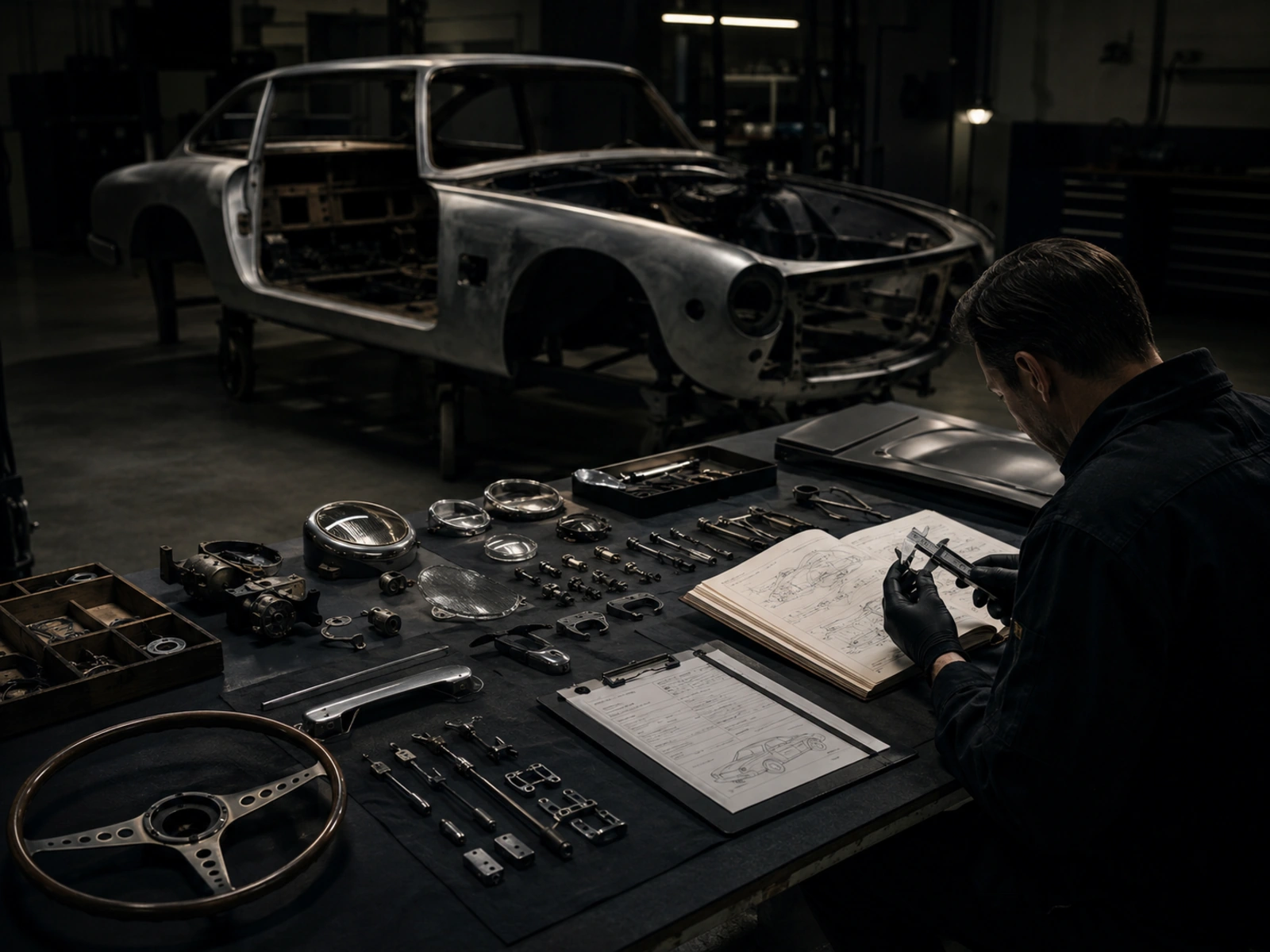
Surface, structure, movement, ergonomics and material condition inform the same decision framework. Wear, neglect, earlier changes and inherent construction characteristics remain different kinds of evidence rather than one undifferentiated problem.
Reading also tests consequences. A visually attractive intervention may weaken usability, hide an important trace or create pressure elsewhere, so the preferred direction remains provisional until its relationships are understood.
03 / Coordinate the direction
Rebuilding connects engineering and craft around one approved direction rather than a collection of isolated upgrades.

Conceptual interventions follow their dependencies. Structural intent informs moving systems, service access informs routing, and cabin choices remain connected to visibility, touch and the overall visual weight of the car.
Every proposed change must support the agreed use while preserving mechanical and visual coherence. Complexity is treated as a cost to understanding, so novelty alone is never a sufficient reason to reinterpret or replace an element.
04 / Make the decisions cohere
Resolve is the point at which separate decisions must behave as one car.

Control relationships, surface transitions, cabin ergonomics and visual restraint are reviewed together at a conceptual level. The aim is not one dramatic feature but a calm consistency that allows the base identity to remain legible.
Resolution can also send the brief backwards. If one choice introduces visual noise, obscures access or weakens another relationship, the responsible response is to reconsider it rather than defend the sequence as already settled.
P / R / R / R
These four responses are a vocabulary for judgement, not an automatic algorithm. Evidence, identity, intended use and consequences shape every choice.
The element or relationship remains part of the project’s identity.
The existing element keeps its role but needs its coherence or function restored.
The original intent remains legible while adapting to the approved way the car could be used.
Replacement is admissible only when the other responses cannot support the project’s purpose.
Replacement is considered only after preservation, repair and reinterpretation no longer support the brief.
GATE / 01—04
Each gate pauses an easy answer and asks what must be known before one area is allowed to change another.
Would this choice protect or blur what makes the project recognisable?
What observation supports the proposed response?
How does this response support the approved character of use?
What new dependency appears if this choice proceeds?
MATRIX / 05
The disciplines form a relationship matrix, not five independent services. Their value lies in what they reveal at the interfaces.
Form, openings, supporting relationships and the continuity of surfaces are read together.
Qualitative resultA coherent structural and visual basis for every later choice.
Response, movement, thermal needs and supporting geometry remain one qualitative conversation.
Qualitative resultA restrained mechanical character integrated with structure and use.
Power distribution, routing, protection and future legibility are considered without decorative complexity.
Qualitative resultA clear, protected and intelligible conceptual system.
Visibility, touchpoints, posture and material transitions define the human reading of the car.
Qualitative resultA legible, calm cabin direction with no unnecessary visual weight.
Surface, edge, junction and sequence reveal whether the preceding decisions truly belong together.
Qualitative resultOne coherent final direction rather than a display of separate effects.
SYSTEM / MAP
Every line in the map represents a question that crosses a boundary: geometry affects response, heat affects materials, routing affects access and final assembly reveals all unresolved conflicts.
VANTA / RESTRAINT
The strongest direction is not the one with the most interventions. It is the one in which every decision can explain its relationship to identity, evidence, use and consequence.